It’s been a while since I wrote here, but with all the talk about avian flu and one case found in Oakland county, it’s time to address it.
Preventing Avian Flu in Backyard Chickens: Tips and Best Practices
Ferndale has long been a community that values responsible backyard chicken keeping. Our backyard chicken regulations are designed to adhere to GAAMPs (Generally Accepted Agricultural and Management Practices), and specific portions of the ordinance play a critical role in maintaining biosecurity. Below, we’ll discuss how these regulations help protect against diseases like avian flu, as well as additional preventative measures chicken keepers can take to safeguard their flocks.
Biosecurity Measures Built into Ferndale’s Ordinance
Ordinance No. 1118 Sec 5-8 includes important provisions to minimize disease risks:
Fully Enclosed Structures: Chickens must be kept in a fully enclosed structure or fenced enclosure at all times. These enclosures must comply with all fence provisions in the Ferndale Code and be constructed of permanent materials, maintained according to the property maintenance code (Sec 6-16 of the Ferndale Code, as amended).
Rodent Prevention: Structures and enclosures must be built and maintained to prevent rats, mice, or other rodents and vermin from being harbored underneath or within their walls.
These measures help reduce the potential for vectors that can spread avian flu and other diseases. Every chicken keeper in Ferndale receives a copy of this ordinance during the permitting and licensing process, and Kathy in the Building Department ensures it’s included with renewal and inspection materials.
Understanding Avian Flu and Seasonal Risks
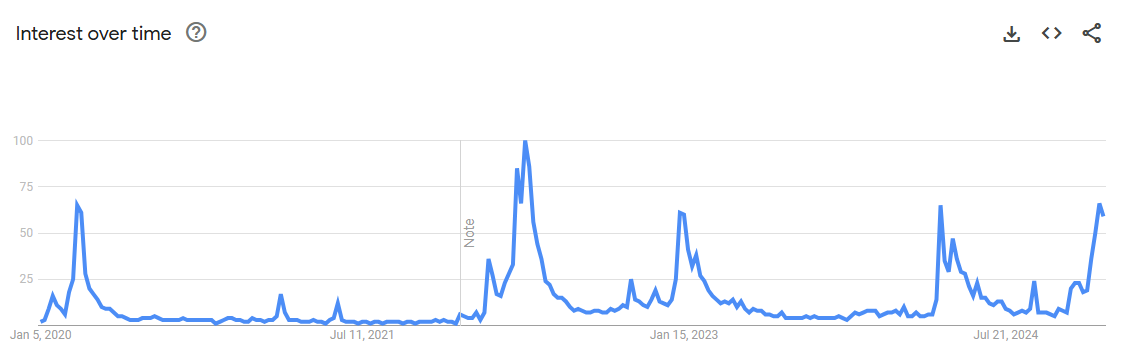
Avian flu has been a hot topic in the backyard chicken community, especially following a major spike in early 2022. You can see in the Google trend below for ‘avian flu’ that this is definitely a regular occurence.
The disease is seasonal and often follows the migration patterns of wild birds, particularly waterfowl. By ensuring chickens are kept in secured coops and runs, as outlined in the ordinance, owners can minimize contact between their birds and wild migratory species, a primary transmission source.
Additionally, maintaining rodent-proof enclosures helps eliminate non-primary transmission risks. Rodents can act as carriers for diseases, so preventing their access to coops is a key part of biosecurity.
Additional Steps to Prevent Avian Flu
While Ferndale’s regulations provide a strong foundation, chicken keepers can further protect their flocks by following these best practices recommended by MDARD and other authorities:
Prevent Contact with Wild Birds: Bring chickens indoors or ensure outdoor areas are fully enclosed to avoid interaction with wild birds.
Practice Proper Hygiene: Wash hands before and after handling chickens and when moving between different coops.
Disinfect Gear: Clean and disinfect boots, tools, and equipment when moving between coops. Avoid sharing supplies between farms.
Secure Feed: Keep poultry feed in a sealed container to prevent contamination by wild birds or rodents.
Use Safe Drinking Water: Provide well or municipal water for drinking, avoiding potential contamination.
Dispose of Non-Disinfectable Equipment: If an item cannot be properly disinfected, discard it to avoid potential transmission risks.
If avian flu is suspected in your flock, it’s crucial to act quickly. Contact MDARD immediately at 800-292-3939 during daytime hours or 517-373-0440 after hours.
Ferndale’s Track Record of Healthy Chickens
Since the passage of our ordinance in 2012, fewer than 50 homes in Ferndale keep chickens, and we have yet to report any cases of major poultry diseases such as Newcastle disease or avian flu. This is a testament to the effectiveness of our regulations and the diligence of our chicken keepers.
We will continue to monitor updates from MDARD and DNR to ensure our community remains informed and prepared to handle any potential risks. By following the ordinance and implementing additional biosecurity measures, Ferndale’s chicken keepers can enjoy their flocks while keeping them healthy and safe.
It’s that time of year again: the yearly outbreak report on human Salmonella cases linked to live poultry. Get ready to clutch your pearls and hide your kids!
Since the last update on June 1, 2017, 418 more ill people have been reported. The most recent illness began on June 20, 2017.
CDC, multiple states, and the U.S. Department of Agriculture’s Animal and Plant Health Inspection Service (USDA-APHIS) are investigating 10 separate multistate outbreaks of Salmonella infections in people who had contact with live poultry in backyard flocks.
These outbreaks are caused by several DNA fingerprints of different Salmonella bacteria: Salmonella Braenderup, Salmonella Enteritidis, Salmonella Hadar, Salmonella I 4,[5],12:i-, Salmonella Indiana, Salmonella Infantis, Salmonella Litchfield, Salmonella Mbandaka, Salmonella Muenchen, Salmonella Typhimurium.
The outbreak strains of Salmonella have infected a reported 790 people in 48 states and the District of Columbia.
Illnesses started on dates ranging from January 4, 2017 to June 20, 2017.
Of 580 people with available information, 174 ill people have been hospitalized. No deaths have been reported.
Epidemiologic, traceback, and laboratory findings link the 10 outbreaks to contact with live poultry, such as chicks and ducklings, from multiple hatcheries.
In interviews, 409 (74%) of 553 ill people reported contact with live poultry in the week before illness started.
Sounds pretty scary, right? 10 outbreaks?! 790 cases? No wonder news outlets hurried to write cutting-edge stories like:
So what does this all mean? Just how much damage are these backyard chickens doing? Why is everyone kissing chickens? What’s WRONG with these chicken people??
When two or more people get the same illness from the same contaminated food or drink, the event is called a foodborne disease outbreak. Similarly, when two or more people get the same illness from contact with the same animal or animal environment, the event is called a zoonotic outbreak.
Simple definition of an ‘outbreak’: any time 2+ people get sick with the same illness anywhere in the US. I should’ve been going into my last corporate job in a biohazard suit every day, ‘cuz it was basically an ongoing outbreak of whatever sickness people picked up from their kids/spouse/etc.
So, what does the “10 outbreaks’ refer to at the CDC? 10 different strains of Salmonella. Two or more people got infected per strain, making it an outbreak.
The Backyard Chicken Salmonella Outbreak Numbers, Put Into Context
The CDC website is not fun to navigate, nor are their tables of data easy to just pull and analyze. Some of the tables don’t even have the states in alphabetical order. Still, it was worth it to satisfy my curiosity and pull the data all into one table. I only pulled data up through 2013, because 2012 was the first year they seem to have Salmonella linked to live poultry and they broke down the reporting into each Salmonella strain, which would have taken me a little too long to merge into this table. Embedded table is scroll-able, or use the link below it to navigate to the Google Sheet showing the full table.
When the numbers stand on their own, it’s easy to get nervous. For instance, I live in Michigan, and was shocked to see 55 cases of Salmonella attributed to interaction with live poultry in 2016. But what percentage of the population is that? How much of an issue are we facing?
Of course, nobody knows how many people keep backyard chickens (even in cities with backyard chicken municipal code & licensing, there are people who keep them without reporting them). So, for giggles, I did some lazy guesswork, just to see what sort of percentages we might be looking at.
Percentage of Chicken Keeping Population in Michigan Who Became Sick With Salmonella in 2017
Let’s make some assumptions:
1.) Let’s assume that all those reported sick from live poultry are actually poultry keepers, not just people who touched or were otherwise around chickens in the 2 weeks prior to getting sick.
4695 members in the Facebook group “Chickens For Sale in Michigan”
2.) Let’s assume that the number of people who keep chickens in Michigan corresponds to the number of members in the Chickens for Sale in Michigan Facebook group, which has 4695 members today.
2017 MI Salmonella Cases
# Chicken Keepers in MI
18
4695
18 is what % of 4,695? .38%
Of course, these are pretty big assumptions, and they’re assuming on the low side. The CDC likes to point out that many people who become infected with Salmonella will never report it, because they might just get a stomach ache & diarrhea and then get over it. Likewise, I think there are far more than 4695 people in Michigan keeping chickens; as support of my theory, I look at forums like BackyardChickens.com and their Michigan Backyard Chicken Keepers thread, which is currently 3964 pages long with a total of 39,635 messages.
Regardless, maybe this 4695 is a big part of our Michigan population, and we need to be worried about those 4695 people getting sick, crippling our economy and overrunning hospitals. How big of a threat potential is there?? Let’s look at 2016 numbers, since I can pull Michigan census data for 2016.
2016 MI Cases
# Chicken Keepers in MI
2016 Pop. of MI
55
4695
9,928,300
4,695 is what % of 9,928,300? .047%
In 2016, our % of sick is actually much higher than where we are right now in 2017. However, chicken keepers, as a whole, are a TINY percentage of the overall population of Michigan, and then only a TINY percentage of them have contracted Salmonella (again, making big assumptions in all cases).
How Are People Getting Sick With Salmonella From Backyard Chickens?
It’s a good question, since it’s so easy to NOT get sick if you practice basic hygiene and use common sense. Basically, the rule is:
Don’t put stuff in your mouth that could be unclean.
It’s a pretty easy concept. Your mom likely drilled it into your head when you were a kid. “Wash your hands” she’d say. “Don’t stick that in your mouth!” She’d scream. Things like that.
Basically, with chickens, you have to assume they’ve gotten in or around poo. I assume the same thing with my dog and cat, honestly, and they get the privilege of sleeping on furniture. If you wash your hands before sticking them in your mouth, and if you don’t go around licking surfaces in your house/yard, you should be fine.
So how are people getting Salmonella from backyard chickens? I have some theories. Welcome to my…
Official Guide to Getting Salmonella from Backyard Chickens
Lick everything. Always.
Clean the coop with your spoon, while you’re eating breakfast.
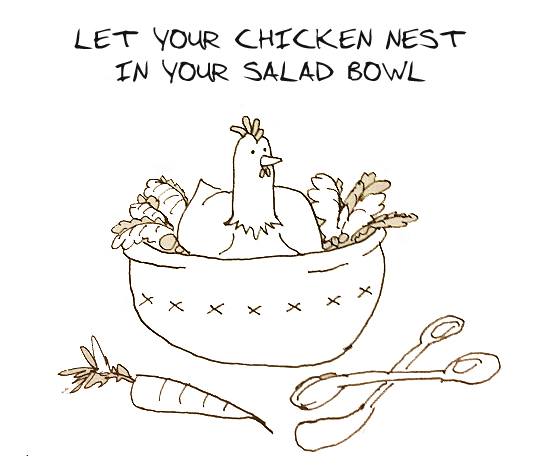
Let your chicken nest in your salad bowl.
Share toothbrushes with your chickens, even though they don’t have teeth.
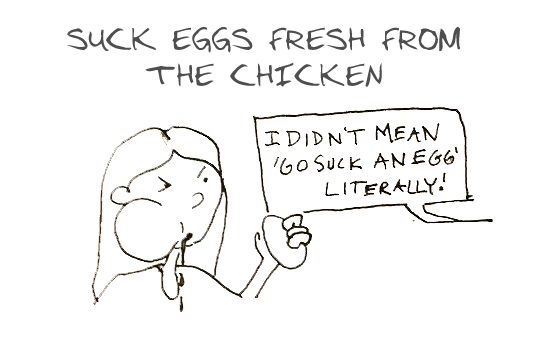
Suck eggs fresh from the chicken.
Let your chickens soak their feet in your tea after a long day of pecking and scratchin’.
Touch chickens then lick your hands.
Drink chicken-stomped wine.
Tongue bathe your chickens.
Keep your chickens toenails short by chewing them.
Important note on ‘Kissing Chickens Causes Salmonella’
All of the above are ludicrous examples, just like insinuating that backyard chicken keepers are all getting sick from getting too ‘intimate’ with their flock, kissing and snuggling them. There are currently 568,000 results for the search “kissing chickens” on Google- all because some remarks from the CDC on ‘kissing, hugging, and snuggling chickens’ blew up into “OMG THESE CHICKEN WEIRDOS ARE BASICALLY MAKING OUT WITH THEIR BIRDS” because that sort of headline gets clicks. It’s dumb, and it paints backyard chickens & their keepers as unsavory, odd people- certainly not the sort of people you want living in YOUR town.
As an example of why this is such a disingenuous tagline for all the stories, here’s a snippet from the 2015 Outbreak Summary:
Twenty-eight (41%) of 69 ill people with complete questionnaires reported keeping baby poultry indoors, 39 (57%) of 69 reported holding or snuggling baby poultry, and 4 (6%) of 69 reported kissing baby poultry. These behaviors increase a person’s risk of a Salmonella infection.
Yes, you read that right: 4 people reported kissing baby poultry in 2015. That was enough to generate high profile articles en masse published in 2015 on Google. Ridiculous headlines get shared, and journalism suffers because of it. Articles like “Salmonella Is Raging Because People Keep Kissing Chickens“. The article leaves out the context of how many people are kissing their chickens, and instead focuses on it like it’s the main issue- and it’s not. The issue is simple hygienic practices, like washing hands, removing shoes when coming into the house, and not putting your mouth on things that have touched poo (I know, I sound like a broken record). Oh, and teaching your KIDS to do that too.
How The CDC Reports Cases of Salmonella Makes It Easy For Naysayers to Fight Against the Legalization of Backyard Chickens
Here’s the crux of why I’m irritated by these yearly reports, and why I think it’s important to change the narrative on salmonella and backyard chickens: as more people strive to work with their city to create ordinances to allow backyard chickens, the alarmist nature of these articles is easy fodder for those who staunchly want to deny backyard chickens in their city. The way the data is being presented, not just by the CDC but also news organizations, is irresponsible and fearmongering.
During the city council sessions in Berkley MI, several people cited concerns over disease and salmonella running wild if backyard chickens were allowed. Luckily rational thought triumphed, but the city is still doing a limited scope ‘pilot program’, just in case- despite the blatant non-issue backyard chickens have been in Ferndale, Royal Oak, Hazel Park, Madison Heights, & Lathrup Village (all surrounding communities).
Every year, I wait for the numbers from the CDC to come out around early June. Every year, I get emails and notes to the Ferndale Backyard Chickens Facebook page, asking about the validity of the articles. And every year I say the same thing: no, I’m not worried about Salmonella. Don’t put poo in your mouth, wash your hands.
When I approached Ferndale back in 2008, the CDC wasn’t pushing press releases out about Salmonella and backyard chickens. I guess the argument can be made that it wasn’t as much of an issue, since fewer people had or were interested in urban chicken keeping. The tides of public opinion have shifted a good deal, but not so much that I’d say your average city dweller thinks backyard chickens are acceptable- and with fearmongering, click-baity articles coming out every year like clockwork, I wonder how public opinion will shift back toward disallowing urban chicken keeping. That’s why I think it’s so crucial to keep this in perspective: only a fraction of a percent of people are getting sick every year, and that shouldn’t be used as ammunition to keep people from being allowed to have chickens.
We, as chicken keepers, NEED to make sure the narrative isn’t one-sided. Share this article with family and friends any time they tag you on another ‘kissing chickens’ outbreak article. Make sure they know that Salmonella isn’t transferred via air, and that basic hygiene keeps people safe. Most of all, let them know they’re safe- this isn’t something your average chicken keeper has to fear, and it isn’t something non chicken keepers need to be concerned about.
My pets eat so much better than I do. As I’m writing this, my lunch consists of a couple spoonfuls of peanut butter and some string cheese. Don’t judge.
If you’re raising egg layers like I am and you really care about feeding them organically, I highly recommend the following brands:
Their Layer Feeds are designed to be the healthiest and most natural product available for your laying hens. While all of their products are soy free, their Naturally Free poultry feed line is both soy free and corn free.
Naturally Free Organic Layer contains a high amount of calcium and slightly lower protein levels than their Naturally Free Organic Grower. The calcium is used by hens to produce strong eggshells and should only be fed to birds that are laying or will lay in the near future. The grains are left naturally whole in this feed rather than highly processed into pellets.
Kalmbach Feeds Organic Layer Feed is exceptional. Headquartered in Ohio (I know most Michiganders don’t like that, but trust me you’ll get over it), their mission is to provide the best animal feed products, quality service and value for their customers and partners- and it shows. They have a strong commitment to transparency as well as quality of ingredients . Derived from the same formula as their crumbles, this organic feed is fortified with essential amino acids and top calcium levels to produce strong shells and wholesome, tasty eggs high in Omega-3 fatty acids and Vitamin D. It contains a proprietary blend of prebiotics, probiotics and enzymes to support digestive and immune health.
Moreover, their feed contains their OmEgga® supplement, which is an extrusion of flax seed with high uptake of omega 3. It’s an easy way to make sure your hens are getting the benefits of flax in the diet (lower risk of ovarian cancer, for instance), while upping the nutrition of their eggs.
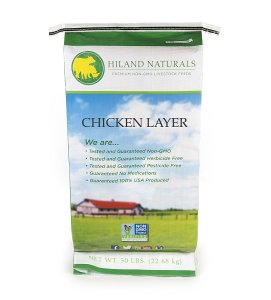
Hiland Naturals of Sugarcreek Ohio makes a great non-GMO chicken feed, and though I’ve never found it in a feed store, you can get it online through Amazon (with shipping included in their price!) or through their website. Their 17% layer feed is a Non-GMO Project Verified, Animal Welfare Approved product intended for layers 16 weeks and older. The slightly lower protein levels and high calcium levels maintain health and provide the birds with the ability to produce strong eggshells. The feed is a blend of non-GMO grains, all natural vitamin-mineral supplement designed specifically for poultry, and direct-fed microbials to keep your birds healthy while promoting production. Their layer feed is Non-GMO Project Verified, Animal Welfare Approved, tested free of herbicides, pesticides, and mycotoxins aflatoxin and deoxynivalenol, and preservative free.
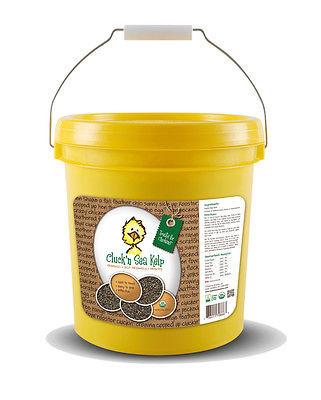
Sea kelp supplement for chickens
Supplementing your feed with sea kelp is a smart way ensure your chickens are getting all the right nutrients to keep them in their prime. By adding sea kelp to your flock’s diet, you have the opportunity to improve their nutrition, boost their immune response and promote egg laying. Some also agree that feeding the flock sea kelp also helps to extend the life of the flock .
Vitamins include A, B1, B6, (NIACIN), B9 (Folate), B12, D, E, and K.
Kelp has very high levels of vitamin K. Vitamin K is necessary for blood clotting and bone health. Kelp also contains high levels of folate, iron, iodine and calcium. The amount of calcium in one serving of sea kelp is ten times the amount found in a glass of milk. As you already know, laying hens require both calcium and Vitamin D to make strong eggshells.
Kelp contains moderate levels of vitamin A, E, C, thiamin, riboflavin, niacin and pantothenic acid.
It also includes important trace minerals–phosphorus, zinc, copper, manganese and selenium as well as lower levels of leucine, lysine, phenylalanine, tyrosine and histidine.
Potential Dietary Benefits
Stronger eggshells
Immune system support
Strong bones and maintenance of bone health
Bright deep golden color egg yolks
Improved plumage- gloss and decrease in feather breakage









 Ferndale Chickens